
Mastering the UK Market: A Deep Dive into Fintechzoom FTSE 100 Analysis
The FTSE 100 Index is the premier benchmark for the Fintechzoom UK stock market, representing the 100 largest companies on the London Stock Exchange. Gaining accurate, real-time data and actionable insights into this global benchmark is essential for investors. Fintechzoom.com FTSE 100 insights provide a popular and comprehensive resource, offering detailed Fintechzoom FTSE 100 analysis that transforms raw market data into strategic investment intelligence. This article examines the index’s structure and how FintechZoom empowers traders to navigate the complex UK equity landscape.
What Is the FTSE 100?
The FTSE 100 Index (UKX) is the composite indicator of the UK’s financial market health, comprised of the 100 most highly capitalized blue-chip companies. Launched in 1984 with a base value of 1,000 points, it remains the most commonly cited measure of the UK equity market.
Definition and Calculation: Capitalization-Weighted System
The index uses a capitalization-weighted methodology. This is the core principle: a company’s impact on the index is proportional to its “free-float adjusted” market capitalization (share price × number of shares available for public trading).
- Impact of Weighting: Because of this structure, a 1% move in a highly weighted stock like AstraZeneca or Shell can move the overall index far more significantly than a 5% move in a smaller constituent. This weighting bias is a fundamental piece of information for any sophisticated FTSE 100 trading strategy Fintechzoom recommends.
The Global Nature of the FTSE 100’s Key Sectors
The FTSE 100 is distinctly international; over 70% of the revenue generated by its companies comes from overseas markets. This global exposure is reflected in its key sector breakdown, emphasized by Fintechzoom FTSE 100 sector analysis:
- Energy & Basic Materials: Dominated by giants like Shell, BP, Rio Tinto, and Glencore, these companies are heavily tied to US dollar-denominated global commodity prices.
- Healthcare & Pharmaceuticals: Firms such as AstraZeneca and GSK drive significant revenue globally, making their performance more reliant on worldwide drug approvals and patent cycles than on the UK domestic economy.
- Financials: Major banks (HSBC, Barclays) and insurers (Prudential) whose profitability is sensitive to global interest rates and exchange rates.
- Consumer Staples: Companies like Unilever generate stable earnings from consumer demand worldwide.
This composition means the index often behaves differently from purely domestic indices, frequently benefiting from a weaker British Pound, as this boosts the sterling value of overseas earnings.
How FintechZoom Covers the FTSE 100
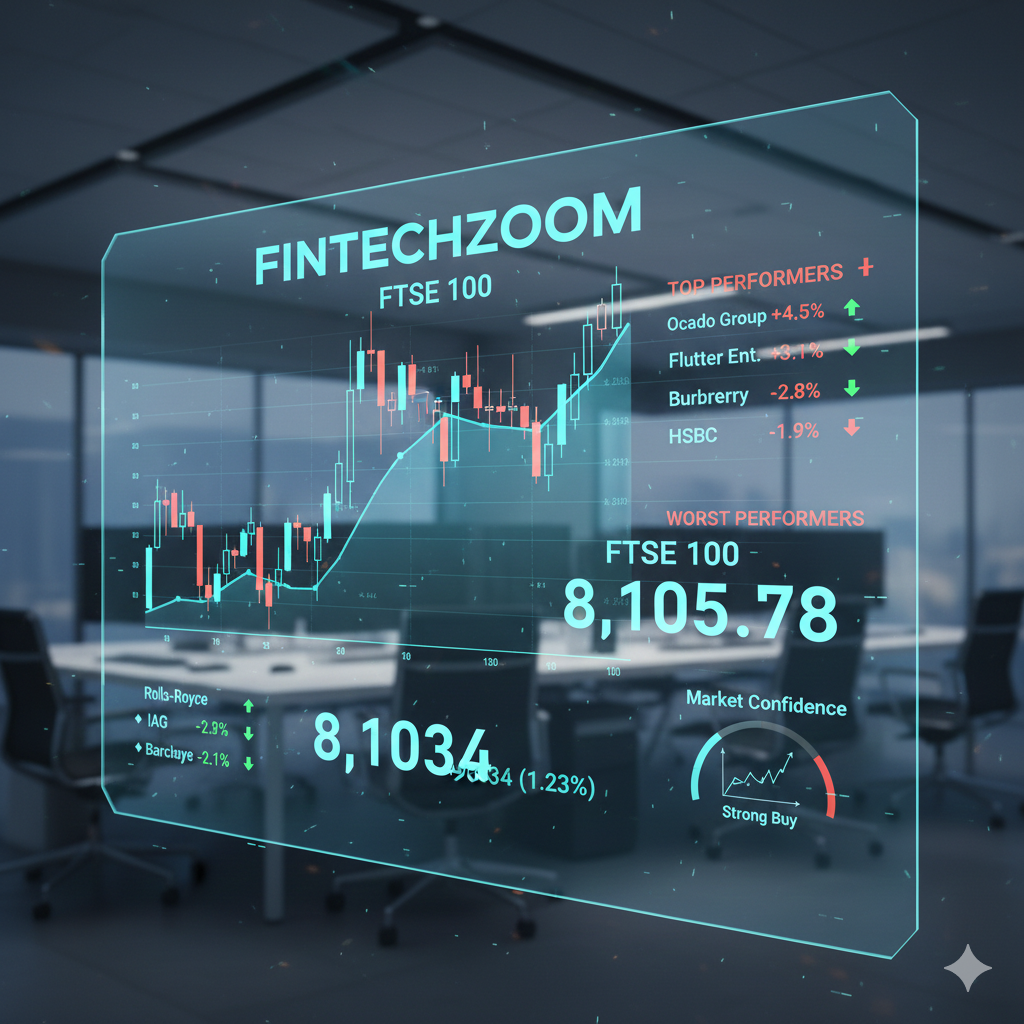
FintechZoom operates as a sophisticated analytical workbench, delivering far more than just raw data. Its integrated approach to market intelligence is key to providing cutting-edge FTSE 100 market updates Fintechzoom users rely on.
Real-Time Price Updates and Data Velocity
For high-frequency or technical traders, data speed is paramount. FintechZoom offers a granular, tick-by-tick feed that powers the FTSE 100 live chart Fintechzoom displays. This rapid data transmission is crucial for:
- Intraday Strategy: Allowing traders to execute strategies based on immediate market reactions.
- Volatility Monitoring: Providing accurate metrics to track Fintechzoom FTSE 100 volatility for real-time risk adjustments.
Integrated Market News and Macro Analysis
The platform ensures that price movements are contextualized with their cause. The FTSE 100 index news Fintechzoom section provides synthesis, explaining the correlation between global, political, and economic events and index performance.
- Monetary Policy: Immediate analysis of Bank of England (BoE) announcements, focusing on how shifts in interest rates impact heavily-weighted financial stocks and the wider index.
- Geopolitical Impact: Quick assessments of global trade tariffs or conflicts, and their direct effect on commodity-linked stocks and defence companies.
Company-Specific Performance Breakdown
FintechZoom’s tools enable a granular FTSE 100 index breakdown Fintechzoom traders use to understand the index’s internal drivers. Users can monitor the daily performance contribution of each stock from the FTSE 100 companies list Fintechzoom maintains. This is vital because index performance often masks weakness or strength in specific, less-weighted sectors.
Tracking Critical Economic Indicators
The platform tracks a curated set of macroeconomic indicators that are most correlated with the index: UK inflation, GDP growth, US dollar strength, and commodity price trends. These data points form the basis for much of the FTSE 100 economic impact Fintechzoom reports on.
FTSE 100 Live Performance on FintechZoom
FintechZoom excels at visualizing complex data for quick decision-making.
The Power of the Live Chart
The FTSE 100 live chart Fintechzoom provides is highly customizable. Traders can apply numerous technical analysis tools to predict short-term price movements and potential reversal points.
- Technical Tools: Users can overlay Moving Averages (MA5, MA50, MA200), the Relative Strength Index (RSI), and MACD indicators to develop a clear FTSE 100 stock analysis Fintechzoom often uses in its own technical reports.
Daily Gainers, Losers, and Sector Rotation
The platform instantly highlights the day’s top risers and fallers. This feature helps identify FTSE 100 price movements Fintechzoom tracks, signaling sector rotation or company-specific news.
| Performance Metric | Insight Gained |
| Top Gainers | Identifies stocks benefiting from positive earnings surprises or sector inflows (e.g., housebuilders after a political event). |
| Top Losers | Pinpoints stocks facing unexpected headwinds (e.g., regulatory fines or profit warnings). |
| Sector Performance | Visualizes which ICB supersectors are driving or dragging the index, crucial for high-level risk management. |
Export to Sheets
Market Sentiment and Volatility Indicators
FintechZoom often includes proprietary sentiment gauges derived from options trading or news flow analysis. High Fintechzoom FTSE 100 volatility—often measured by the VIX equivalent—signals market fear or uncertainty, prompting risk-averse investors to adjust their strategies.
Major Companies and Their Index Impact
A small number of high-weighting companies exert disproportionate influence on the index. Consistent tracking of these entities is critical for reliable FTSE 100 performance Fintechzoom statistics.
Case Study: High-Weighting Constituents
- AstraZeneca (AZN): A defensive pharmaceutical giant, its share price movements have a significant (often >7%) weighting impact. News on drug trials or financial results are key drivers of FTSE 100 stock performance Fintechzoom.
- Shell (SHEL) & HSBC (HSBA): Representing Energy and Financials, respectively, their share prices are often inversely correlated: Shell benefits from a weak Pound/high oil price, while HSBC’s revenue is sensitive to global interest rates and credit conditions.
- Unilever (ULVR): A consumer staples behemoth, its stable earnings often offer protection during economic downturns.
A major corporate event, such as a major delisting (which the index has seen in recent years), can impact the index’s capitalisation by billions, demonstrating why Fintechzoom FTSE 100 highlights often revolve around these top constituents.
Factors Affecting FTSE 100 Movements
The price changes, or FTSE 100 price movements Fintechzoom reports, are a product of complex domestic and global forces.
Global Economic and Political Conditions
Due to its large international revenue base, the FTSE 100 is highly exposed to global stability. A recession in the US or Europe will immediately dampen earnings forecasts for UK multinationals, particularly those in Basic Resources or Industrials.
UK Monetary Policy and Domestic Events
While global factors are strong, domestic policy remains a significant influence, especially for sectors focusing on the UK consumer.
- Bank of England Rates: Decisions directly affect lending rates for banks and borrowing costs for all companies.
- Currency Fluctuation (GBP/USD): A critical factor. A weaker GBP can lead to higher FTSE 100 index values because non-Sterling profits (the majority) are converted back into more Pounds. This is a core element of the FTSE 100 daily analysis Fintechzoom provides.
Commodity Prices and World Market Correlations
The performance of oil, gas, and metal prices drives the Energy and Basic Resources sectors. Furthermore, the FTSE 100 maintains strong correlations with major world indices, a constant focus of Fintechzoom financial news FTSE 100 reports.
FintechZoom’s Expert Insights and Forward-Looking Analysis
FintechZoom’s most crucial offering is translating data into forward-looking, high-value Fintechzoom FTSE 100 investment insights.
Aggregation of Analyst Forecasts and Market Scenarios
The platform compiles and distills FTSE 100 predictions Fintechzoom sources from institutional research. This goes beyond simple price targets to model various scenarios.
- Valuation Comparison: Reports often show how the FTSE 100’s Price-to-Earnings (P/E) ratio compares favorably (e.g., 14x) to other major indices like the S&P 500 (e.g., 20x+), making the UK market look undervalued.
Investment Strategies and Risk Guidance
FintechZoom serves as a valuable FTSE 100 trading guide Fintechzoom users rely on for strategic advice and risk management.
- Thematic Focus: Highlighting current market themes, such as defence spending or green energy transition, and suggesting exposure adjustments within the index.
- Risk Profile: Advising on managing Fintechzoom FTSE 100 volatility through diversification or the use of exchange-traded funds (ETFs) that track the index.
Decoding FTSE 100 Trends
The analysis helps distinguish between short-term market “noise” and fundamental trend change. FTSE 100 market trends Fintechzoom analysis focuses on long-term signals, often bolstered by Fintechzoom FTSE 100 expert opinion on where the index is heading over the next 6 to 12 months.
How Investors Leverage FintechZoom for FTSE 100 Trading
The platform is designed to cater to diverse investor profiles, from the novice interested in understanding the market to the professional managing large funds.
Technical Traders: Charting and Alerts
Technical traders rely on the FTSE 100 live chart Fintechzoom provides to identify technical support and resistance levels. They use automated price alerts to signal entry or exit points, allowing them to react instantly to confirmed FTSE 100 price movements Fintechzoom tracks.
Fundamental Investors: News and Financial Overview
These investors use the FTSE 100 financial overview Fintechzoom provides to assess core corporate fundamentals: dividend yields, P/E ratios, and earnings reports. The detailed Fintechzoom FTSE 100 report is their main document for strategic reviews.
Positional Traders: Sentiment and Daily Analysis
Swing traders utilize the FTSE 100 daily analysis Fintechzoom offers, combining technical timing with FTSE 100 commercial insights Fintechzoom publishes regarding sector strength and market sentiment.
Conclusion
The FTSE 100 is a globally relevant benchmark offering high exposure to international markets and stable, dividend-paying companies. For navigating this complex index, Fintechzoom FTSE 100 analysis is an essential tool. By integrating real-time data, macroeconomic context, and expert forecasts, FintechZoom transforms raw market movements into clear, actionable intelligence. Leveraging the comprehensive Fintechzoom FTSE 100 report is the most effective way to manage risk and achieve successful trading outcomes in the UK market.
Frequently Asked Questions
Q1. Is the FTSE 100 updated in real time on FintechZoom?
Yes. FintechZoom provides real-time, streaming data during LSE trading hours. This ensures zero data lag, which is crucial for precise execution based on FTSE 100 market updates Fintechzoom publishes.
Q2. How reliable is FintechZoom market data, and where does its expert opinion come from?
FintechZoom maintains reliability through verified data providers and financial exchanges. Fintechzoom FTSE 100 expert opinion is sourced from a combination of in-house analysis and aggregated reports from tier-one investment banks.
Q3. Which factors contribute most significantly to FTSE 100 performance?
The dominant factors are global commodity prices (oil, mining), the strength of the US Dollar vs. the Pound, and the corporate earnings of the 10-15 largest constituents (e.g., AstraZeneca, Shell). The overall FTSE 100 stock performance Fintechzoom charts show is driven by these few large stocks.
Q4. Can beginners use FintechZoom for trading insights?
Yes. The platform’s clear presentation of the FTSE 100 index overview Fintechzoom offers, coupled with educational resources and daily summaries, makes the advanced Fintechzoom FTSE 100 analysis accessible to beginners.
Q5. How often do the companies in the FTSE 100 companies list change?
The constituents of the FTSE 100 companies list Fintechzoom maintains are formally reviewed quarterly (March, June, September, and December).